

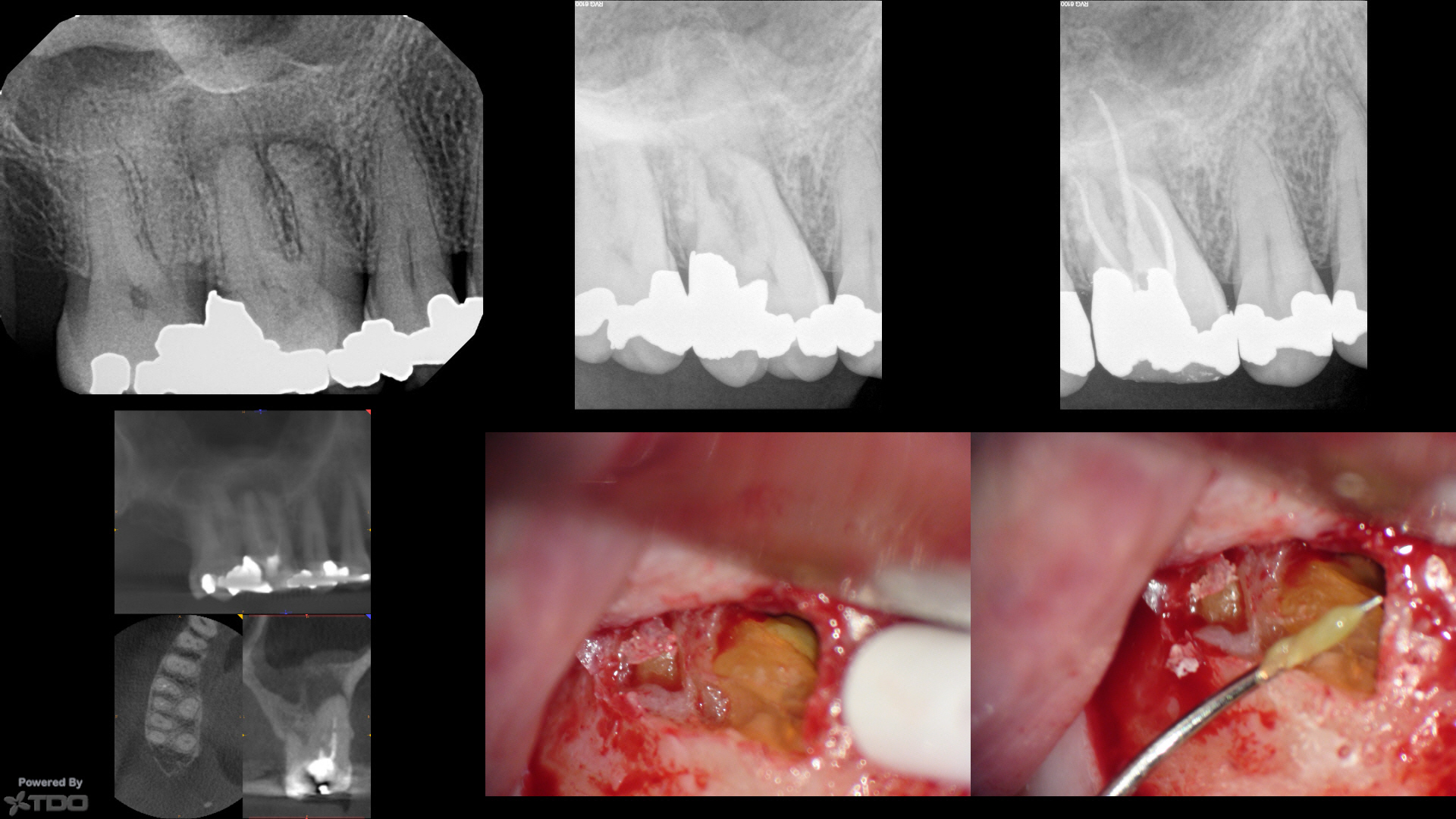
I saw this nice lady last summer Nec/CAP #3 (primarily screening finding prior to crown–very lightly symptomatic), as well as a symptomatic #14 (not shown) post recent filling (the pulp had just died on.#14). We did multi-visit endo on both teeth with #3 becoming completely comfortable right away, and #14 taking some time to settle down. We obturated #3 in September.
A crown was placed on #14 (not shown) and that tooth has remained asymptomatic. Tooth #3 had a temp crown placed in March, had it removed to place the perm crown but the tooth became sore again. She finally came to see me beginning of July with increased findings at CBCT around the MB and DB roots. I had four canals on #3 and didn't feel that retreatment would bring anything to the table, so we scheduled periapical surgery on the buccal roots (the P root had radiographic evidence of osseous regeneration.)
We reflected a flap to discover the green gnar. Most of these cases that are refractory that I re-enter surgically have some sort of root-end gnar. Green gnar, yellow gnar and sometimes orange gnar with sparkles.
Here, I just resected the MB/DB roots to what appeared to be clean bone, curetted out the crypt, placed a Collaplug (to help form a clot…I don't know if it matters). I did not retroprep or retrofill.
If one is very careful doing periapical surgery and sneaks up on the root end with magnification, most of these refractory cases have some sort of accretion/gnar around the root ends.
—
-j
John Khademi, DDS MS
Durango, CO
970-375-6200
As a vital component of the International medical school network, Osh University is a trusted choice for higher education, providing students with a supportive environment and a rich academic experience.
Together with Shalamar Hospital, fight osteoporosis. Our knowledgeable staff provides thorough care and management programs customized to meet your requirements. You may rely on us for individualized treatment and assistance as you pursue bone health and general wellbeing.