


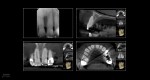
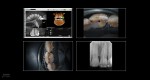
Dynamic navigation has been in dentistry for many years. It remains in its infancy in endodontics but is proving to be very helpful for the access of calcified teeth. This is a case from yesterday in which dynamic navigation was used to allow for a conservative access while locating the calcified canal. -Charles
Of course if the Endodontic Triad was an accurate representation of our disease model, what you claim might be true. Unfortunately, most of us feel the Endodontic Triad model is a total fiction—as are all inferences that spring from that model.
gbc
Hi Craig,
First off, I think we can both agree that the white line does not tell the story. This was not a one file in and out case. While the largest rotary file used was a 20/04, a 15/02 was used for multiple recapitulations.
Under the traditional dogma, this would be categorized as underprepared. However, as Gary has mentioned we have began to question the endodontic triad. My contention would be that these larger apical preps are mismanaged. In the end, the proof will be in the pudding. I’ll post the recalls as they role in.
The same role it played under the old system albeit a much less destructive role. If I could remove the file completely I would.
What role do you subscribe the files to playing in the current dogma?
Craig,
You and I both are aware of the traditional/current dogma as well as the new contentions. Like I said, I’ll post the recalls as they come in.
Sorry for the delayed reply. What is the most common method of failure of an endodontically treated tooth? The role of the file has not changed. However, we know we are not rendering the tooth “bacteria free” no matter the dimensions of the endodontic file. What we do know is that the more tooth structure we remove, the weaker the tooth will be.
To describe the Endodontic Triad as a “contention” I think misses what we are trying to say. What we are saying is that the Endodontic Triad is more of a “tautology”—a formula, repeated in different ways, over and over again, until it loses any meaning tethered to actual observations..
We use the word in the rhetorical meaning, not the meaning it has in propositional logic. It means it is automatically assumed to be a correct formula without checking out whether it satisfies all the variables possibly present in the model. And here the Triad fails miserably because it can’t explain what we observe everyday: Cases that should fail by any standard, but don’t.
The first component of your endodontic triad is shaping. The focus of the new endodontic triad is the peri-cervical dentin.
For many cases I will utilize the exisiting restoration for the access. Due to the increased difficulty of the access of this case I made the choice to perform the access guided and with the angle to give me the best success to locate the canal conservatively. This goal was accomplished. Furthermore, going through the incisal edge does not go against the preservation of PCD. This is the area of concern.
I’m still waiting for your answer of the most common mode of failure of an endodontically treated tooth.
Part of the role of a community like this is to help each other move beyond our own cognitive illusions by making us think about complex models in a different way—in order to test them and figure out if they are really just a tautology…… So…let’s try working this from another direction.
Based on you model, if you had a completed case with trillions of bacteria still present at the terminus at the time of completion, how would that case do? Trillions of bacteria present both at the terminus and on the external root surface. What does your model tell you what the outcome would be? If not immediately, then at 10 years. 20 years?
gbc
Have you resulted to pandering to new graduates to get the answer you want? New graduates are among the very last from whom I would be seeking answers. They need to unlearn most of what they are taught. Since you are showing cases I showed the attached case to several patients today. One is my molar the other is yours. I asked them which would they prefer on their tooth. They all said the one with the small hole. The non-DDS seem to get this and don’t understand what the discussion is about. A structural engineer was quick to point this out at the IAE meeting as well. To be a doctor is to understand that our specialty is at a crossroads with implants. Endodontically treated teeth are said to be brittle. To be a doctor is to understand that while Herb Schilder was a brilliant mind we now have better armamentarium that allow us to accomplish our goals in a conservative manner. I posted two recalls for you this week showing healing of MIE cases. As for the ad hominem attack of forcing the patient’s mouth open to keep up with Jones’s is something I would not do. I strive to be respectful to every patient I treat. I too could dive into the ad hominem’s but don’t want to further alter the direction of this discussion. We should be able to have a respectful discussion regardless of our varying opinions.
I’ll once again ask, what is the most common mode of failure of an endodontically treated tooth?
This sounds like Pannkuk. Terry…didn’t Herb Schilder talk about “The Look” as embodied by the radiographic appearance? Ruddle seems to think so:
More than 30 years ago, Schilder’s article, “Cleaning and Shaping the Root Canal,” was published.1 In what has become a classic article, he presents brilliant concepts and defines the 5 mechanical objectives for shaping canals and cleaning root canal systems. Schilder completely understood that, logically, the dimensions of these smooth-flowing, funneled preparations would necessarily and appropriately vary relative to the anatomy of any given root (Figures 1a and 1b). Schilder fully appreciated that well-shaped canals would exhibit “the look,” improve the potential for 3-dimensionally cleaning and filling root canal systems, and fulfill the biological objectives for the retention of critically essential teeth (Figure
Impressive demonstration, Charles. Nice utilization of technology. Equally impressive is the lack of voids in such a small space 🙂
Hi Brandon,
A composite warmer makes a world of difference in helping with voids. https://vista-dental.com/therma-flo-composite-warming-kit/